Bike-skill milestones by age.
A simple, evidence-based ladder for what a child should be able to do on a bike, and roughly when. (Spoiler: balance bikes change everything.)
April 13, 2026
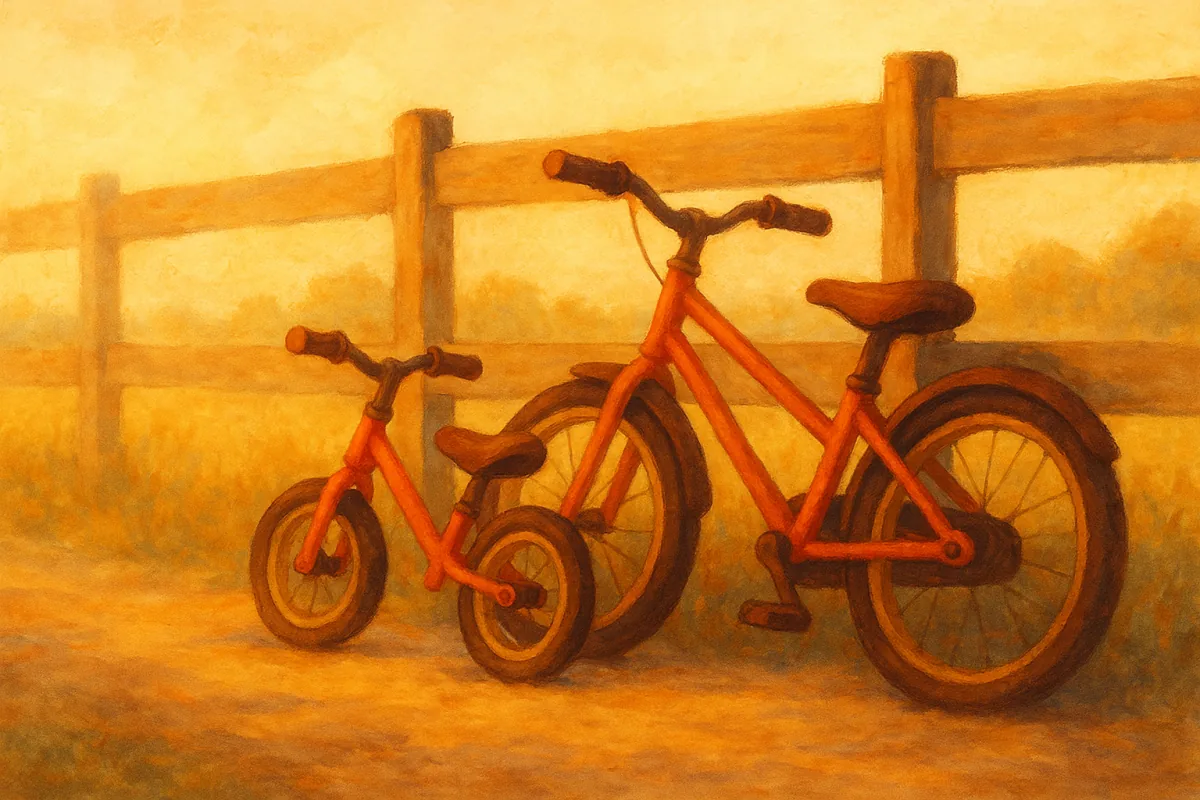
Cycling is one of the highest-value motor skills a child develops in the first decade. Done well, it gives them a 5 km perimeter by age 9, which roughly maps onto the independent-mobility radius their grandparents had at the same age.
The milestones below are average; individual variation is wide and that's fine.
The ladder
18-24 months. Sit on a balance bike and walk it forward. Total distance: a few metres.
2-3 years. Glide on a balance bike with both feet up. Steer around a cone. (The Dutch peuter-fiets data from the Onderzoek Veilig Verkeer Nederland surveys consistently finds that children who skip stabilisers and go from a balance bike to a pedal bike learn faster and fall less than children who started on stabilisers.)
3-4 years. First pedal bike. Most children on a balance-bike background skip stabilisers entirely; they balance on day one and then learn to pedal. Allow a week of grass-falling for the pedalling co-ordination.
5-6 years. Ride confidently on a quiet street, brake when asked, look over their shoulder. Can ride a quiet 1 km loop.
7-8 years. Ride safely on shared paths. Can ride a 3-5 km loop with one or two minor stops. This is roughly the walking-to-school distance on two wheels.
9-10 years. Ride independently in low-traffic neighbourhoods, including controlled junctions and shared roundabouts. Can do a 10 km loop with a friend. This is the age the Netherlands starts the school-administered bike test (verkeersexamen).
11-12 years. Cycle to school independently in moderate traffic. The Dutch national norm at this age is that ~80% cycle to school alone.
Three principles that beat any milestone chart
- Balance bike first, always. This is the single biggest learning accelerator we know about.
- Real road, not just the playground. Bike-handling improves an order of magnitude faster on actual surfaces with actual obstacles.
- Friction-free access. A bike that lives next to the door is ridden. A bike in the basement isn't. Same logic as a yard you can walk into without asking.
When to worry
Almost never. If a 6-year-old still can't balance on a pedal bike, the cause is almost always too little practice, not a motor-skill issue. Twenty minutes a day for two weeks fixes most cases.
If genuine motor co-ordination concerns persist past 7 (across many activities, not just cycling), bring it up with the GP. That's a different conversation.
Sources
- Onderzoek Veilig Verkeer Nederland. *Verkeersexamen primair onderwijs - jaarcijfers.* VVN, multiple years (NL national bike test data).
- Mercê, C. et al. "The use of balance bikes in early childhood: a systematic review." *Frontiers in Sports and Active Living* 3, 2021.
Read next
The science of the schoolyard scrape.
A bruised knee is not a parenting failure. It is, almost certainly, a regulatory upgrade in your chi...
Friendship is a skill. Your kid needs to practise.
The number of close friends a person has at 30 is set, mostly, by the friendships they made in perso...
Walking to school: the one-mile test.
If you live within a mile of the school, the walk is one of the highest-value parenting decisions yo...