Friendship is a skill. Your kid needs to practise.
The number of close friends a person has at 30 is set, mostly, by the friendships they made in person between 7 and 14. The current generation is short on the practice.
April 28, 2026
Robert Putnam's Bowling Alone (2000), then his follow-up Our Kids (2015), made a careful argument that the slow erosion of "casual local sociability" since the 1970s, the daily low-stakes contact with people you didn't choose, was the single biggest predictor of adult civic disengagement. He didn't write specifically about kids. The data since suggests he should have.
What friendship in childhood actually does
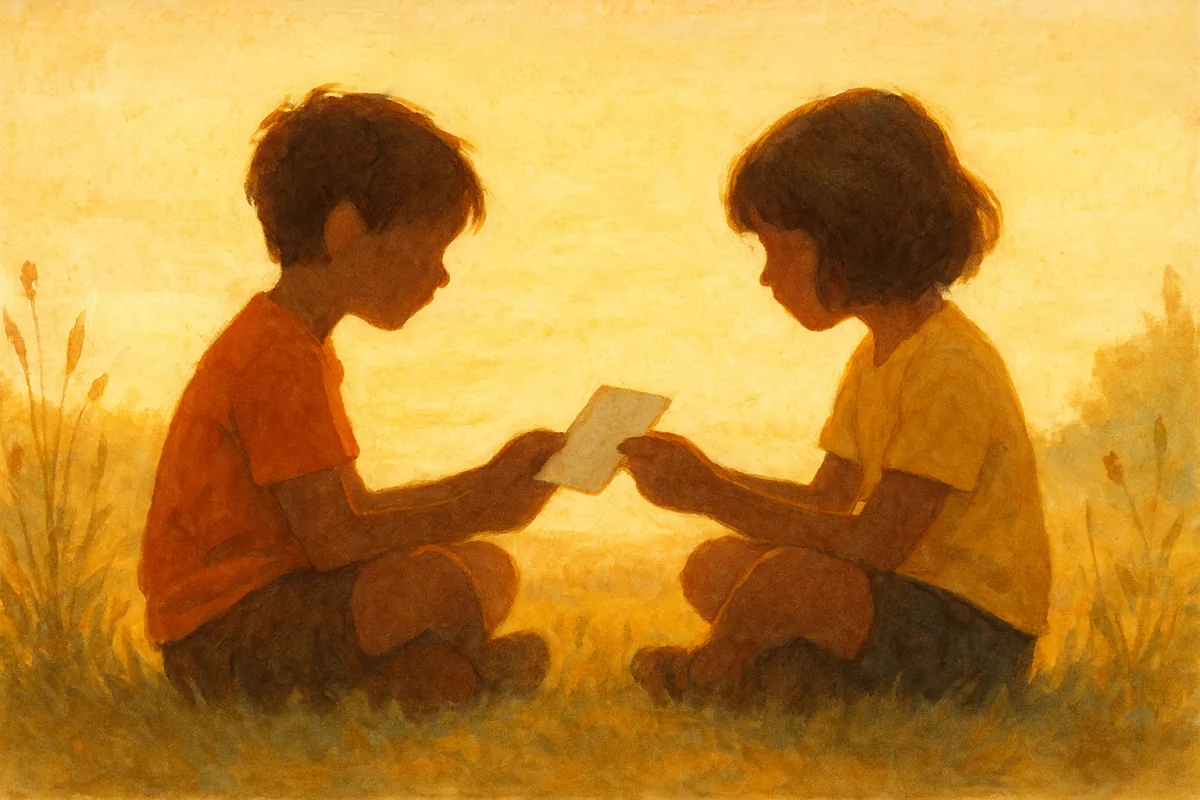
A close friendship between 7 and 14 is not, primarily, fun. It is a training ground. The child:
- Negotiates conflict with someone they want to keep.
- Learns to read another person's face for cues their own internal state isn't generating.
- Practises repairing a relationship they've damaged.
- Discovers that loneliness is survivable, and that returning to a friend after a fight is also survivable.
None of that is something a child can do alone. None of it is something a child can do well through a screen. The Robin Dunbar group at Oxford has shown repeatedly (Sutcliffe, Dunbar et al., British Journal of Psychology, 2012) that close friendship requires a certain minimum amount of in-person time per week. Online contact maintains an existing friendship. It does not, on its own, build one.
The 2010s shift
There is a now-well-known data series in the U.S. teen survey Monitoring the Future: the percentage of high-schoolers who reported "almost daily" in-person time with friends fell from a stable ~50% from 1976-2010 to under 30% by 2017. The drop coincides exactly with smartphone adoption. (Twenge, iGen, 2017; updated in Generations, 2023.)
Time spent in person with friends did not get redistributed evenly to time-spent-with-friends-online. It was, mostly, replaced by time alone with a phone.
What this looks like in your house
A parent's instinct, looking at a 10-year-old who isn't making friends easily, is often to schedule them into something. That works, partially. But the research suggests the part that matters isn't the activity. It is the unsupervised social time around the activity. The walk home together. The wait between rounds. The hour after class.
This is what unstructured outdoor time provides almost incidentally. It is also why the WHO 60-minute target is, in practice, much easier to hit when a friend is involved: kids playing tag forget to keep time.
A small intervention that works
Pick one Saturday afternoon a month. Tell your child to invite one friend. Tell the other parent the same. Drop them somewhere with grass, no plan, and a 4pm pickup. Repeat it.
You will not see the gain in week one. By month four, you will. The literature on friendship formation is consistent: closeness scales with the cube root of unstructured shared hours. There is no shortcut, but there is no large minimum dose either.
The free-range mom got this for free. The modern parent has to engineer it. The good news is that engineering one Saturday a month is not a heavy lift, and the friendship a child builds in that time will, on the data, still be theirs at 30.
Sources
- Putnam, Robert D. *Bowling Alone: The Collapse and Revival of American Community.* Simon & Schuster, 2000.
- Putnam, Robert D. *Our Kids: The American Dream in Crisis.* Simon & Schuster, 2015.
- Twenge, Jean M. *iGen.* Atria Books, 2017. *Generations.* Atria Books, 2023.
- Sutcliffe, A., Dunbar, R., Binder, J., Arrow, H. "Relationships and the social brain: integrating psychological and evolutionary perspectives." *British Journal of Psychology* 103(2), 2012.
Read next
The science of the schoolyard scrape.
A bruised knee is not a parenting failure. It is, almost certainly, a regulatory upgrade in your chi...
Walking to school: the one-mile test.
If you live within a mile of the school, the walk is one of the highest-value parenting decisions yo...
Bike-skill milestones by age.
A simple, evidence-based ladder for what a child should be able to do on a bike, and roughly when. (...