The science of the schoolyard scrape.
A bruised knee is not a parenting failure. It is, almost certainly, a regulatory upgrade in your child's nervous system.
May 6, 2026
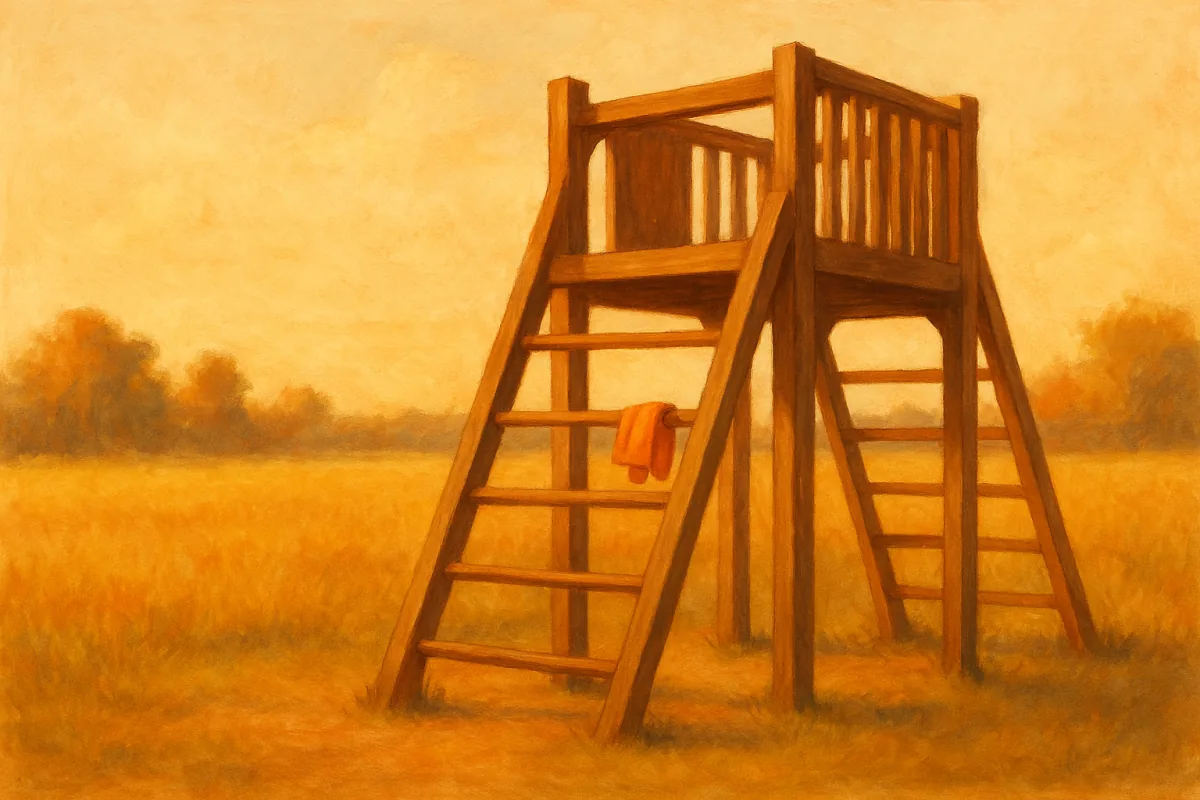
There is a category of parent who reads "fall risk" on a piece of playground equipment and concludes, sensibly, that the risk should be removed. The research is fairly clear: removing it does not make children safer. It makes them more anxious.
Ellen Sandseter, a Norwegian play researcher, has spent two decades studying what she calls "risky play". Her categorisation, which has become standard, lists six kinds: great heights, high speeds, dangerous tools, dangerous elements (water, fire), rough-and-tumble, and going somewhere alone. In her 2011 Evolutionary Psychology paper she argues that all six are, in moderate doses, evolved tools for emotion regulation. They reduce anxiety. They do not increase it.
What a small fall actually does
When a child takes a manageable fall off a low climbing frame, three things happen at once:
- Their amygdala spikes ("ow, this is scary").
- They self-soothe by getting up and looking around ("I am okay").
- The next time they encounter that situation, the spike is smaller.
This is the same loop that makes graded exposure therapy work for adults with phobias. It is also what does not happen when a child has spent every afternoon on a screen.
Why "child-led" matters more than "safe"
Sandseter and Kennair's 2011 review distinguishes carefully between child-led risk (climbing the tree they chose) and adult-imposed risk (an obstacle course an adult set up). Child-led risk is calibrated, by the child, to a level just barely beyond their current ability. Adult-imposed risk usually isn't. Most playground injury statistics are about the second.
This is also why most modern playgrounds, with their rounded plastic and recycled-tyre flooring, are quietly worse than the ones the parents grew up with: they are calibrated to a single risk level for the average child of the average age. They do not let a brave seven-year-old find their own ceiling.
The link to anxiety
There is now a small literature linking the decline in risky play to the rise in childhood anxiety disorders. Gray et al.'s 2023 paper in the Journal of Pediatrics puts it most clearly: "Independent activity, including play, fosters intrinsic motivation, problem-solving, emotion regulation, friendship, and a sense of personal responsibility and competence." When you remove the activity, you remove the practice.
What to do at home
You don't need to install a climbing wall. You need to:
- Pick the lowest defensible bar for "this is going to get them hurt seriously" and let everything below it through.
- Resist the urge to coach the climb. Let the child set the height.
- When a small fall happens, acknowledge it once and move on. Do not narrate the fall.
If you'd rather think about this as a rhythm than a rule, the chapter on the streetlights rule is the same idea at the level of the afternoon. The free-range mom is the same idea at the level of the year.
A scraped knee is not a parenting failure. It is, in the most literal sense, a child's nervous system getting better at the world.
Sources
- Sandseter, E.B.H. "Children's Risky Play from an Evolutionary Perspective: The Anti-Phobic Effects of Thrilling Experiences." *Evolutionary Psychology* 9(2), 2011.
- Sandseter, E.B.H. & Kennair, L.E.O. "Children's Risky Play from an Evolutionary Perspective." *Evolutionary Psychology* 9(2), 2011.
- Gray, P. et al. "Decline in Independent Activity as a Cause of Decline in Children's Mental Wellbeing." *Journal of Pediatrics* 260, 2023.
- Brussoni, M. et al. "What is the Relationship between Risky Outdoor Play and Health in Children?" *International Journal of Environmental Research and Public Health* 12(6), 2015.
Read next
Friendship is a skill. Your kid needs to practise.
The number of close friends a person has at 30 is set, mostly, by the friendships they made in perso...
Walking to school: the one-mile test.
If you live within a mile of the school, the walk is one of the highest-value parenting decisions yo...
Bike-skill milestones by age.
A simple, evidence-based ladder for what a child should be able to do on a bike, and roughly when. (...