The 1980s mom was not actually negligent.
Two generations of research on independent mobility tell a story most parents don't hear: the radius your child is allowed to roam is now about a fifth of what yours was, and the country isn't safer.
April 30, 2026
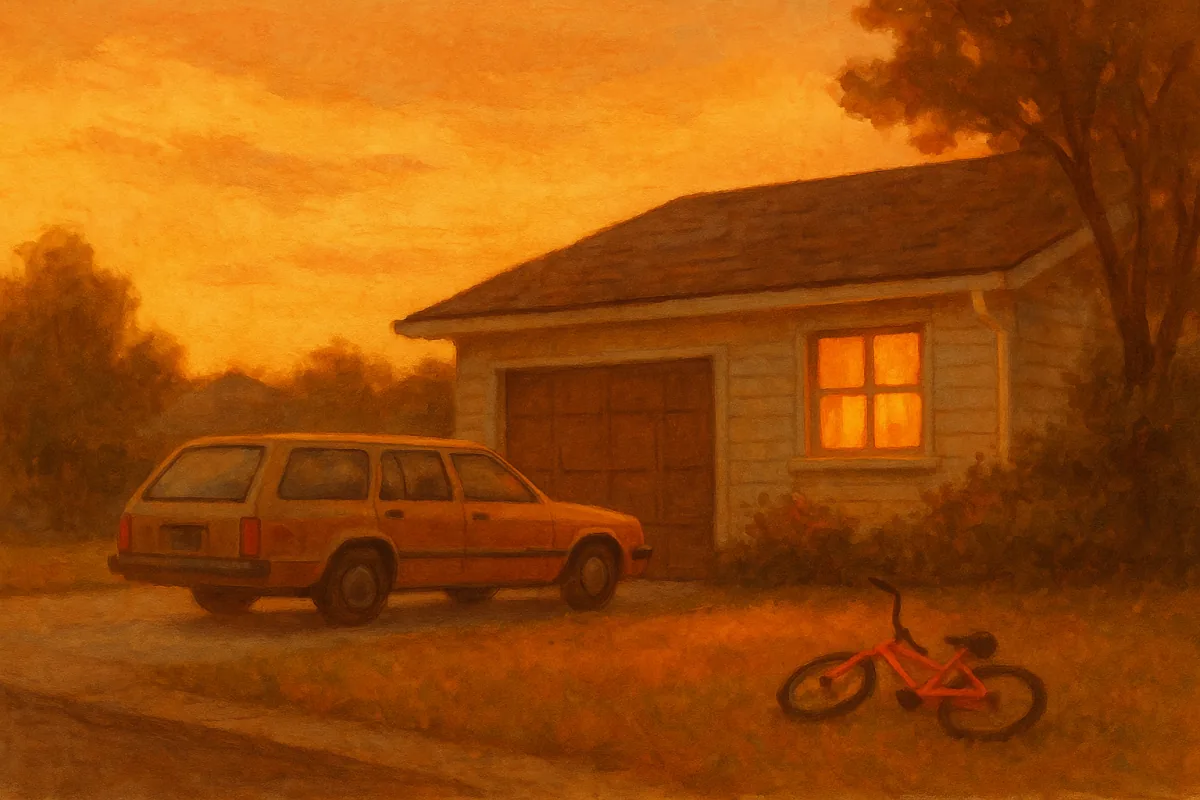
If you grew up before 1995, you almost certainly walked to school by yourself by the age of nine, played out of sight of any adult for most of the afternoon, and had a defined "you can be on this side of the train tracks" perimeter that you respected. Your mother wasn't being neglectful. She was working with the data of her time, which was that the actual risk to a child outdoors was small and the cost of indoor confinement was real.
Two-thirds of the way into 2026, the data has not changed in her favour. The perception has.
The Hillman & Adams data
The Policy Studies Institute's Children's Independent Mobility series, started by Mayer Hillman in 1971 and updated by Adams in 1990, 2010 and 2015, is the most-cited dataset on this. The headline figures from the UK arm:
- In 1971, 80% of seven- and eight-year-olds were allowed to walk to school alone. By 1990 it was 9%. By 2010 it was 6%.
- The radius from home a 10-year-old was allowed to travel without an adult fell roughly 80% between 1971 and 2010.
- Over the same period, traffic fatalities involving children fell, abductions of children by strangers remained extremely rare and stable, and "stranger danger" reports to police rose dramatically while actual incidents did not.
The same pattern shows up in the Dutch (KiM Netherlands Institute, 2018), Australian (Schoeppe et al., 2013) and Finnish (Kytta, 2004) datasets.
What changed, if not the risk
Two things, mostly:
The information environment. Local news in the 1990s discovered that abducted-child stories, especially the rare and horrifying ones, were extremely good for ratings. The cumulative effect on parental risk perception is well-documented (Glassner, The Culture of Fear, 1999). Parents in surveys consistently estimate stranger-abduction risk as 1000x its actual rate.
The structure of the day. Two-earner households became the norm; afternoon supervision moved from "the street" to "the after-school programme". The street emptied as a side-effect of working parents needing scheduled childcare, not as a response to risk.
The cost of the new default
Lenore Skenazy's 2008 column on letting her nine-year-old ride the New York subway alone became, depending on the audience, either child-endangerment or the founding text of the Free-Range Kids movement. The hate mail was real. The research that has accumulated since is broadly on her side. From the Brussoni et al. systematic review (IJERPH, 2015) onwards, the literature has been consistent: confining children "for safety" produces measurable costs in physical fitness, anxiety regulation, problem-solving and friendship formation.
It also produces a secondary cost most parents don't notice: a child who has never been independently mobile at age 10 is, predictably, less safe at age 14 when independence is finally given. The skill of navigating the world is built incrementally. The child who hasn't built it doesn't suddenly possess it.
A defensible modern version
You don't need to mail your child across town. You need to:
- Pick a perimeter your child knows and respects, and let them roam inside it without check-ins.
- Teach them three concrete things: how to ask an adult for help, how to find their way home, and what to do if a friend is hurt.
- Avoid the live-tracker. It removes the very signal you're trying to grow.
The streetlights rule is the structural version of this. The risky-play research is the developmental version of why it works.
The 1980s mom wasn't being negligent. She was being efficient with her supervision, in a way that has turned out to be measurably good for her kids. We can be that mom again, on slightly modified terms.
Sources
- Shaw, B. et al. *Children's Independent Mobility: An International Comparison and Recommendations for Action.* Policy Studies Institute, London, 2015.
- Skenazy, Lenore. *Free-Range Kids: How to Raise Safe, Self-Reliant Children.* Jossey-Bass, 2009 / 2021 update.
- Brussoni, M. et al. "What is the Relationship between Risky Outdoor Play and Health in Children?" *IJERPH* 12(6), 2015.
- Glassner, Barry. *The Culture of Fear.* Basic Books, 1999.
- Kytta, M. "The extent of children's independent mobility and the number of actualized affordances as criteria for child-friendly environments." *Journal of Environmental Psychology* 24, 2004.
Read next
A rainy-day kit. Twelve things that work.
Outzy is mostly an outdoor app. On the days when outdoor isn't happening, here is the short list of...
When your kid says they're bored.
Boredom is the engine of every interesting thing your child has ever made up. Don't solve it.
The first ten minutes after school. A parenting cheat-code.
How you handle pickup determines about half of how the rest of the day goes. The interventions are t...