The streetlights rule, and why it actually worked.
A generation of children grew up with one bedtime cue and very little supervision. The science of why that was good for them is finally catching up.
May 10, 2026
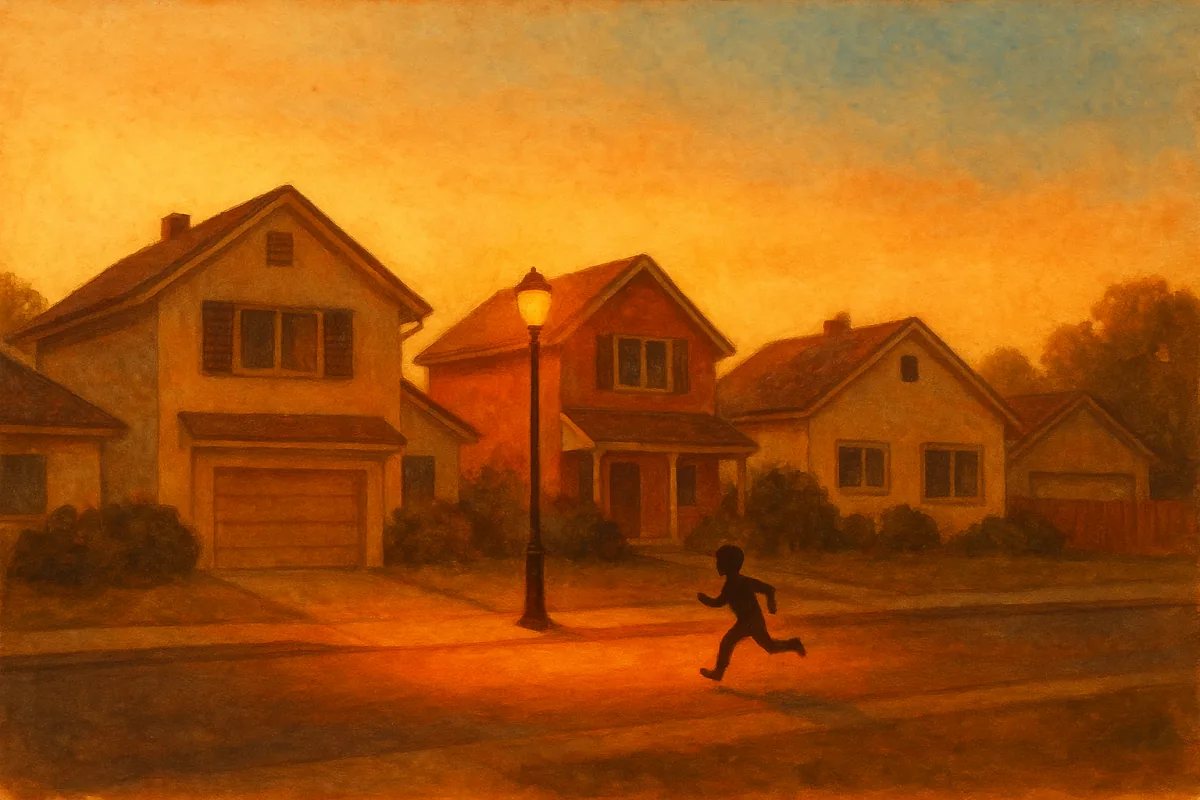
If you grew up between 1975 and 1990, your "be home by" rule was probably a light bulb. The lampposts came on, you came home. There was no group chat, no live tracker, no shared calendar. The street was the calendar.
It turns out the streetlights rule wasn't laziness. It was a near-perfect schedule for a child's nervous system.
What unstructured outdoor time does to a child
Peter Gray, a research psychologist at Boston College, has spent two decades arguing that the long decline in unsupervised play is the strongest predictor of the rise in anxiety and depression among children since the 1980s. In Free to Learn (2013) he frames it bluntly: when you remove the daily slot in which a child is in charge of their own time, you remove the main place they learn to be in charge of themselves.
The American Academy of Pediatrics agrees with the diagnosis. Its 2018 clinical report on the power of play states that "play is not frivolous", and that the loss of unstructured play time has "tangible consequences" for a child's social, emotional and cognitive development.
That doesn't mean kids need a wilderness. They need a block, a yard, a stretch of sidewalk and an adult who can resist the urge to schedule it.
Why the streetlights worked
Three things, mostly:
- Predictability. A child knew the cutoff. A parent knew the cutoff. Nobody had to negotiate it at 5:14pm.
- Visibility. The cutoff was a visual signal in the world, not a notification. Kids self-regulated by looking up.
- Trust. The rule was the only contact for the whole afternoon. There was no check-in. The child got to feel responsible because they were responsible.
Those three things are exactly what most modern parental controls remove.
The "1980s mom" defence
If this all sounds like a roundabout way to defend the parents who let their kids out, that's because it is. Lenore Skenazy's Free-Range Kids movement, which I touch on in The 1980s mom was not actually negligent, has been arguing for years that the modern parent's perception of risk is far higher than the actual risk a child faces outside.
There is also a body of research, summarised by Hillman and Adams (2012, Policy Studies Institute, Children's Independent Mobility), showing that the radius a child is permitted to roam has shrunk by ~80% in two generations. That collapse correlates almost exactly with the rise in childhood obesity, social anxiety and time spent in front of a screen.
What a modern "streetlights rule" looks like
You do not need to install nostalgia. You need to install the three properties above:
- A predictable, visible, child-known cutoff.
- A short list of places the child knows are theirs.
- A trust contract that explicitly does not include a check-in.
If the family has Outzy, that's exactly what the 60-minute outdoor target is for. If they don't, a wristwatch and a kitchen window will do.
The streetlights rule wasn't the past being better. It was the past being a structure children could understand. We can give that back.
Sources
- Gray, Peter. *Free to Learn: Why Unleashing the Instinct to Play Will Make Our Children Happier, More Self-Reliant, and Better Students for Life.* Basic Books, 2013.
- Yogman, Garner, Hutchinson et al. "The Power of Play: A Pediatric Role in Enhancing Development in Young Children." *Pediatrics* 142(3), American Academy of Pediatrics, 2018.
- Hillman, Adams, Whitelegg. *Children's Independent Mobility: An International Comparison and Recommendations for Action.* Policy Studies Institute, 2015 update.
- Skenazy, Lenore. *Free-Range Kids: How to Raise Safe, Self-Reliant Children.* Jossey-Bass, 2009 / 2021 update.
Read next
A small yard still counts.
You don't need a wilderness, you need a defined patch of outside the kid is allowed to use without a...
Winter outdoor play that actually works.
Cold weather is not the reason your kids are inside. Lack of routine is. Here is what Scandinavian f...
What the Netherlands gets right about outdoor childhood.
A few specific Dutch practices that produce one of Europe's highest outdoor-childhood rates. Most ar...