A small yard still counts.
You don't need a wilderness, you need a defined patch of outside the kid is allowed to use without asking.
April 16, 2026
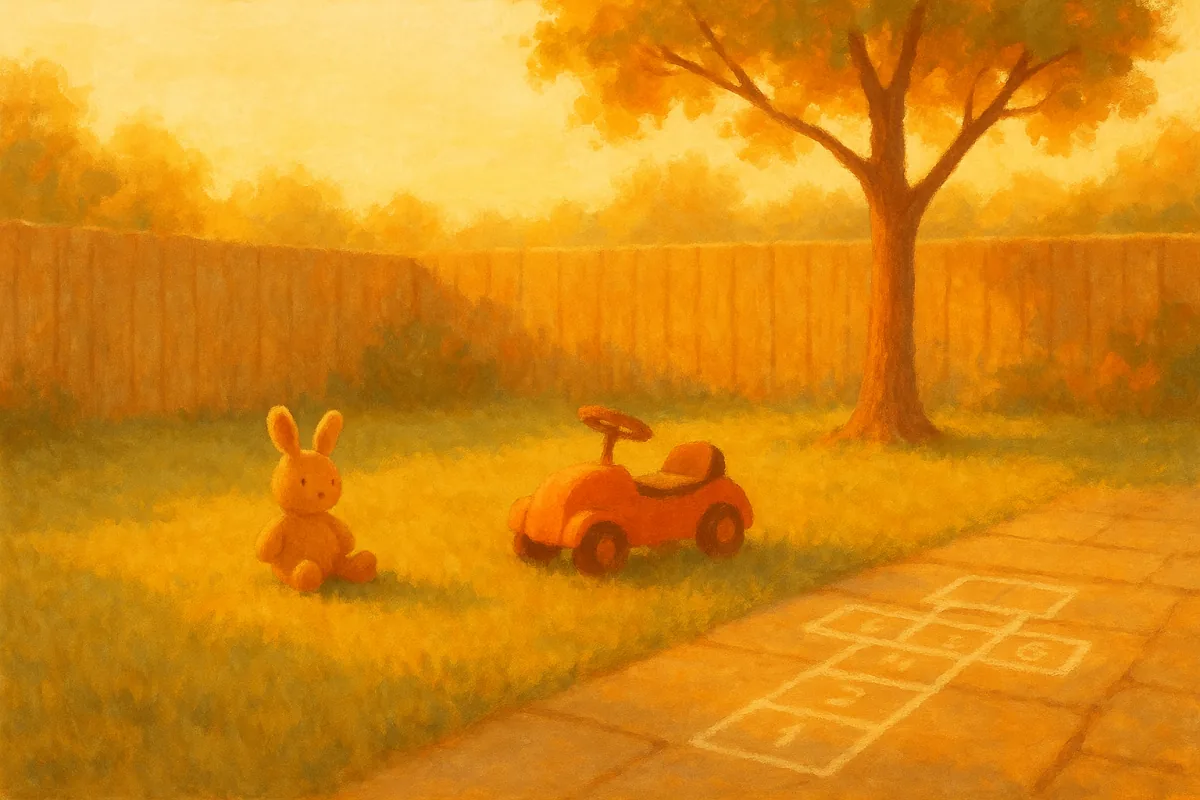
A common parental anxiety: "we live in a flat / row house / dense neighbourhood with a tiny garden, our kids can't really play outside". The research disagrees. The variable that matters isn't size. It's defined access.
Marketta Kytta, the Finnish environmental psychologist, ran a series of cross-country surveys on what she calls "actualised affordances": the count of outdoor things a child is actually allowed to do without asking. A 50-square-metre garden the kid can use whenever they want consistently scores higher on outdoor wellbeing than a 5-acre park they have to be driven to (Kytta, Journal of Environmental Psychology, 2004).
Why size doesn't matter as much as you think
Three reasons:
- Children invent. Six square metres of grass is a forest, a battlefield, a kitchen, a fort, a stage. We've watched ours play hide-and-seek in a yard with two trees and a bin.
- The gear matters more than the space. Our rainy-day kit works in a hallway. Outdoor kit (chalk, a ball, a stick, a marble) works in a single sidewalk square.
- Friction kills frequency. A patch the kid can use without asking is used. A park 15 minutes away with two siblings to coordinate is used twice a month.
What "defined access" looks like in practice
- A door the kid can open by themselves.
- A perimeter they know and you trust them inside.
- A standing yes, not a per-trip ask.
- One hour of the day that is "outside time", not negotiable.
Combine that with a clear cutoff and most kids will hit the WHO 60-minute target on a Tuesday in a 30-square-metre garden.
What to add when the yard is genuinely small
Three cheap upgrades, in order:
- Chalk. Hopscotch, a target, a path, a story. Resets every rain.
- A ball, any ball. Counts get tracked. Counts beat last week's count.
- A bucket of "outside-only" toys. Marbles, a frisbee, a kite kit, a magnifying glass. Stays outside, even in light rain.
The walk to a friend's house adds a fourth dimension at zero garden-size cost. On letting kids do that walk alone: the data is on your side.
Sources
- Kytta, M. "The extent of children's independent mobility and the number of actualized affordances as criteria for child-friendly environments." *Journal of Environmental Psychology* 24, 2004.
- Brussoni, M. et al. "Risky outdoor play and health in children: a systematic review." *IJERPH* 12(6), 2015.
Read next
The streetlights rule, and why it actually worked.
A generation of children grew up with one bedtime cue and very little supervision. The science of wh...
Winter outdoor play that actually works.
Cold weather is not the reason your kids are inside. Lack of routine is. Here is what Scandinavian f...
What the Netherlands gets right about outdoor childhood.
A few specific Dutch practices that produce one of Europe's highest outdoor-childhood rates. Most ar...