What the Netherlands gets right about outdoor childhood.
A few specific Dutch practices that produce one of Europe's highest outdoor-childhood rates. Most are copyable.
April 6, 2026
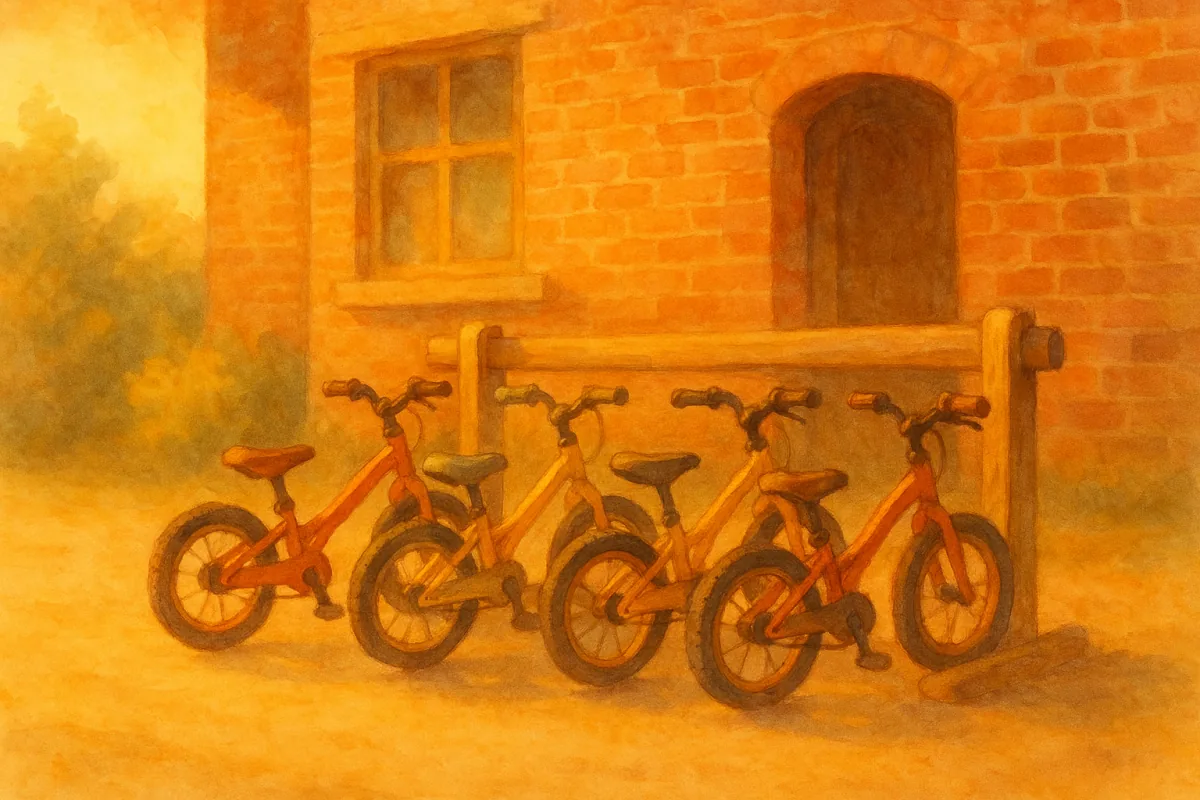
The Netherlands has, by most measures, one of the highest outdoor-childhood rates in the rich world. Dutch children walk and cycle to school more than any peer country, log more independent outdoor mobility minutes, and report among the highest child-wellbeing scores in UNICEF's repeat surveys (UNICEF Innocenti Report Card 16, 2020).
This isn't an accident. There are a handful of specific things Dutch families and Dutch infrastructure do that other countries could copy.
The five specifics
1. Cycling is the default. Dutch primary schools assume children cycle to school by 9. Bike racks are sized for it. Streets near schools have separated cycle paths. The bike-skill ladder we describe is the Dutch ladder; it's just standard. The school administers a national bike test (verkeersexamen) at 11 with a >90% pass rate.
2. The buurt (neighbourhood) is the unit. Dutch towns are designed so that primary-aged children have a defined buurt — typically a few hundred metres in radius — where adults broadly know whose kid belongs to whom. This is the social context that makes the streetlights rule actually safe to apply. The buurt is built into the housing design; it doesn't appear by accident.
3. Outdoor time at school is non-negotiable. Most Dutch primary schools have at least 30 minutes of outdoor break in the morning and another 30-45 at lunch. The wet-weather rule is "light rain doesn't cancel". Why this matters.
4. Holidays are short and outside-heavy. Dutch school holidays are short relative to the UK or US. Long stretches at home produce more indoor time, more screen time, and more sibling friction. Shorter holidays plus a culture of de-aging-out outdoor sports clubs (hockey, korfbal, voetbal) keeps the outdoor routine going.
5. Parents accept some risk. The Dutch parental risk threshold is, on the international comparison data, several notches higher than the UK or US norm. This is approximately where the rest of Europe was 30 years ago; the Netherlands didn't follow the rest of us into the post-1990s panic.
What is copyable
You can't change the design of your suburb. You can change:
- The expectation that your child cycles to school by 9.
- The default that they roam a defined perimeter without check-ins.
- The rule that outdoor break, including yours after school, is non-negotiable.
- The decision to enrol them in a local outdoor sports club with a 10-minute walking radius, not a 30-minute drive.
If you cluster three out of four of those, you have, functionally, a Dutch childhood with a Belgian / German / British / American postcode.
What you cannot copy
The cycling infrastructure. That requires political work over a generation. But the cultural part of the Dutch result was actually built on top of that infrastructure, not the other way around. The cultural part is portable on its own.
Sources
- UNICEF Office of Research-Innocenti. *Worlds of Influence: Understanding what shapes child wellbeing in rich countries.* Innocenti Report Card 16, 2020.
- Onderzoek Veilig Verkeer Nederland. *Verkeersexamen primair onderwijs - jaarcijfers.* VVN, current year.
- Schoeppe, S. et al. "Children's independent mobility: a systematic review and ecological analysis of 16 countries." *Journal of Transport & Health* 2(3), 2015.
Read next
The streetlights rule, and why it actually worked.
A generation of children grew up with one bedtime cue and very little supervision. The science of wh...
A small yard still counts.
You don't need a wilderness, you need a defined patch of outside the kid is allowed to use without a...
Winter outdoor play that actually works.
Cold weather is not the reason your kids are inside. Lack of routine is. Here is what Scandinavian f...