What good screen time actually looks like.
Not all screen time is the same screen time. The research is unusually clear on which kinds are net-positive, which are neutral, and which are just sitting still in front of variable rewards.
April 22, 2026
The "screen time bad" framing is a useful starting point and a terrible finishing point. Not all screens are the same. The research, going back to the Sesame Workshop educational studies of the 1970s and forward to the Common Sense Media reports of the 2020s, sorts screen time into three rough categories.
The three categories
Active, interactive, with another person. A video call with a grandparent, a game played co-operatively with a sibling, a homework session with a tutor. This category is essentially neutral or slightly positive on every wellbeing axis the literature has studied. The American Academy of Pediatrics explicitly carves it out: video chat is permitted from infancy, where all other screens are not.
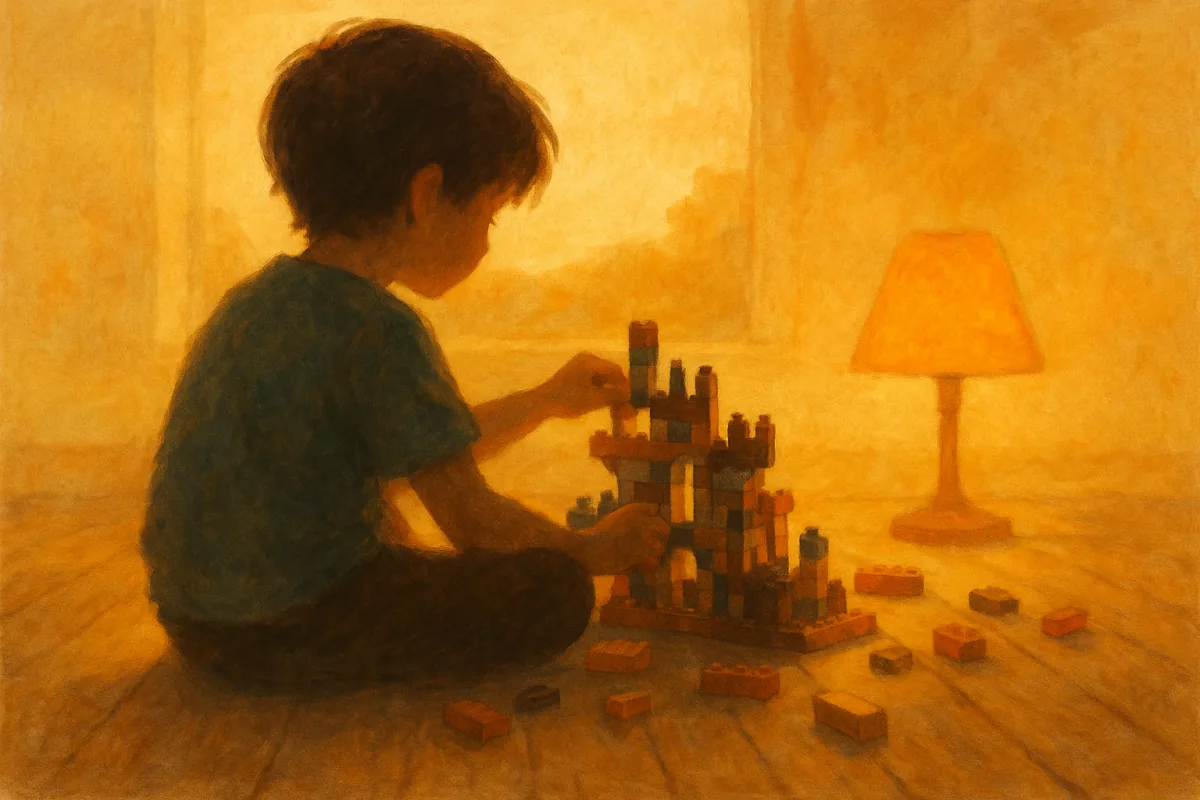
Active, single-player, mostly creative. Building in Minecraft, a music-creation app, a puzzle game, a coding tutorial. The research here is mixed-to-positive. Granic, Lobel & Engels's 2014 American Psychologist paper "The benefits of playing video games" is the canonical synthesis: improvements in spatial reasoning, persistence under failure, and short-term mood. The caveats: total time still matters, sleep still matters, and creative apps tend to be net-positive while pure-progression games tend to be net-neutral.
Passive, variable-reward, single-player. Endless short-video feeds (TikTok, YouTube Shorts, Reels), notification-driven social apps, idle clickers. This is the category the dopamine research is mostly about. Across the cohort studies (Twenge & Campbell, 2018; Orben & Przybylski, 2019; Haidt 2024), this category is the one most strongly associated with anxiety, sleep problems and attention difficulties. Not because the content is uniquely bad, but because the schedule of the content trains the brain badly.
The practical heuristic
If you want a single question to ask about a screen activity: "Is this making something, or is it served to them?"
Made things are mostly fine. Served things are mostly the problem.
Common Sense Media's 2024 Common Sense Census on tween/teen media use found that the average 8-12-year-old spent 5 hours 33 minutes per day with screens, of which the largest single slice was passive video-watching. The smallest slice was creation. The order is the wrong order.
Where this lands at home
You don't need to ban categories. You need to invert the proportion. A child who spends more screen time making than receiving is, on the data, fine. A child who spends 90% of their screen time receiving is, on the data, statistically more likely to show mood and sleep problems within a year.
This sits next to the sleep rule (devices out of the bedroom) and the 60-minute outdoor target. Together they cover roughly 80% of what the screen-time conversation is actually about.
The other 20% is just culture in your house. Talk about what you watched. Watch with them sometimes. Show them what you make on a screen. Children learn the relationship to screens from the relationship the adults in the room have with screens.
Sources
- Granic, I., Lobel, A., Engels, R.C.M.E. "The benefits of playing video games." *American Psychologist* 69(1), 2014.
- Orben, A. & Przybylski, A. "The association between adolescent well-being and digital technology use." *Nature Human Behaviour* 3, 2019.
- Twenge, J.M. & Campbell, W.K. "Associations between screen time and lower psychological well-being among children and adolescents." *Preventive Medicine Reports* 12, 2018.
- Common Sense Media. *The Common Sense Census: Media Use by Tweens and Teens, 2024.* Common Sense, 2024.
Read next
Why your kid's brain wants the screen.
It is not weakness, it is not addiction in the casual sense, and it is not your fault. It is a calib...
A phone-free childhood: where to start.
Jonathan Haidt's four norms, translated into actions a normal family can take this month.
Indoor recess is hurting your kid's afternoon.
When schools cancel outdoor break for weather or staffing, the next two hours of class are measurabl...